Dynamic Balancing Explained: Keeping Machinery Running
If you run equipment with anything spinning at speed, dynamic balancing matters. It is one of those jobs that can feel optional until vibration starts shaking bolts loose, bearings fail early, or a machine becomes too noisy to ignore. The frustrating part is that imbalance rarely announces itself with a single, neat fault. Instead, it shows up as a mix of vibration, wear, heat, noise, and “it just doesn’t feel right”.
This guide explains dynamic balancing in plain terms, including rotor balancing and fan balancing, what typically needs repairing before balancing, and the types of components that can be balanced. It is written for a UK audience, with examples that fit industrial, agricultural, and commercial machinery.
Throughout, I’ll reference how All Terrain Engineering approaches the work, including inspection, corrective repairs, and reporting.
What is dynamic balancing?
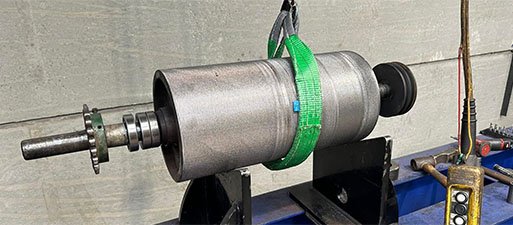
Dynamic balancing is the process of correcting uneven weight distribution in a rotating component while considering how it behaves when it spins. In simple terms, it is how you get a rotor, fan, drum, or shaft to run smoothly at operating speed, without wobble or harmful vibration.
A quick everyday comparison is a car wheel. If the wheel is out of balance, you might not notice much at low speed, but at motorway speed you feel vibration through the steering wheel. The fix is not guesswork. The wheel is spun, the heavy spot is identified, and small weights are added so the wheel rotates evenly. The same principle applies to industrial rotors and fans, just with tighter tolerances, higher forces, and bigger consequences.
Dynamic balancing focuses on rotating parts “in motion”, because some imbalances only reveal themselves when the component is spinning. This is different from static balancing, which checks balance at rest.
Rotor balancing vs fan balancing: what’s the difference?
Rotor balancing is the broad category. A rotor is any rotating assembly, and it shows up in plenty of equipment: electric motors, pumps, gearboxes, mulchers, flail mowers, turbines, rollers, drums, and more. Rotor balancing is about correcting uneven mass distribution so the rotor spins smoothly, with minimal vibration and wear.
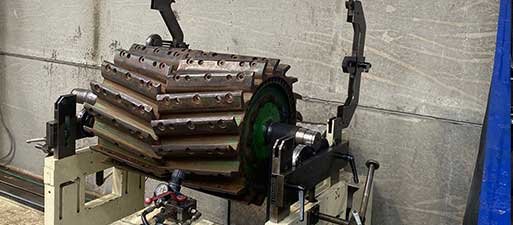
Fan balancing is a specific type of rotor balancing focused on fans and impellers used for ventilation, extraction, cooling, and process airflow. Fans can be particularly sensitive because a small change, like dirt build-up on blades or a slightly bent shaft, can cause noticeable noise and vibration. All Terrain Engineering highlights common fan symptoms like vibration, noise, overheating, and reduced airflow, which are classic signs of imbalance or damage.
Why dynamic balancing is done
Dynamic balancing is done to reduce the knock-on effects of imbalance. When a rotating component is heavier on one side, centrifugal force pulls that heavy point outwards as it spins. The faster it spins, the stronger that force becomes. That force transfers into the machine frame, bearings, mounts, and surrounding components.
Balancing helps you:
- Minimise vibration so the machine runs smoothly and predictably.
- Extend bearing and shaft life by reducing cyclic loading and uneven wear.
- Reduce noise, which often improves working conditions and can be an early warning signal in itself.
- Improve efficiency, because energy is not being wasted shaking the machine.
- Lower maintenance costs by preventing repeat failures and reducing unplanned downtime.
- Improve safety, especially where high-speed components can fail catastrophically if vibration is left unchecked.
And there is a practical point people often forget. If you balance a component properly, you get a clearer baseline. Future vibration checks become more meaningful because you are not trying to diagnose other faults through the “noise” of an imbalance.
The hidden truth: balancing rarely works if repairs are skipped
A lot of rotating parts are not simply “out of balance”. They are worn, bent, cracked, or damaged. If you try to balance something that is not straight or not structurally sound, the balance result can be misleading, short-lived, or completely ineffective.
All Terrain Engineering is direct about this: before balancing, components are assessed and repaired as needed. The goal is to make sure the part is straight, structurally sound, free from damage, and within tolerance.
This matters because balancing is about weight distribution around a true axis of rotation. If the axis itself is compromised, you are chasing your tail.
What needs to be repaired before dynamic balancing?
The exact machining repairs depend on the component and what caused the issue, but the common themes are consistent across industries.
- Straightness and runout issues (bent shafts and rotors)
If a shaft is bent, the rotor will not rotate around a consistent centreline. That shows up as runout and vibration. Straightening is often the first major step.
All Terrain Engineering specifically offers rotor and shaft straightening (also called cylindrical shaft straightening) and notes that even slight bends can make balancing ineffective and lead to premature failure.
They also state capability to straighten items like flail mower rotors (with shafts up to 3.5 metres), crankshafts, rollers, augers and paddles, hydraulic rams, and drive shafts. - Cracks, fatigue, and structural damage
Cracks and fatigue damage are not “nice to have” fixes. They are safety issues. A cracked rotor can change shape under load, shift mass distribution during operation, and worsen imbalance. It can also fail suddenly.
In practice, this is why inspection and crack assessment sit before balancing in a proper workflow. - Worn bearing journals, fits, and mating surfaces
If bearing seats or keyways are worn, the rotor might not sit correctly when installed, even if it is balanced in isolation. That can create misalignment, looseness, and recurring vibration that looks like imbalance.
This is where machining and corrective fitting work come in. All Terrain Engineering notes repairs and machining as part of the process before balancing. - Distortion, dents, and impact damage
Impact damage (common in agricultural and forestry equipment) can deform a rotor tube, shift welded features, or bend end plates. You can balance around damage temporarily, but if the shape is distorted the part may not stay stable at speed.
The practical fix is often straightening, repair welding, and then balancing once the geometry is restored. - Dirt build-up, corrosion, and material loss
Build-up on blades or rotors changes mass distribution. Corrosion can add rough, uneven deposits or remove material in patches. Either way, balance is affected.
Cleaning and surface prep can be part of “repairs before balancing”, depending on the part. The key is that the component must be in a stable condition before you measure and correct imbalance.
Single-plane and two-plane balancing (and why it matters)
Not all rotors behave the same way. A short, rigid component often only needs correction in one plane. A longer rotor usually needs correction at both ends because imbalance can exist along the length.
- Single-plane balancing for short, rigid rotors, suitable for items like small fans, pulleys, flywheels, and propellers.
- Two-plane balancing for longer or more flexible rotors where weight distribution must be corrected at both ends, such as flail motors, drums, industrial rollers, and long shafts.
They also note balancing capability up to 3m length for single and two-plane correction, and they use hard-bearing balancing machines with vibration sensors and phase-angle analysis for high-precision results.
What machinery can be dynamically balanced?
Dynamic balancing services applies anywhere rotating mass matters. Some components are obvious, others get forgotten until they start causing problems.
Here is a practical list, including the items you asked to cover and the categories All Terrain Engineering regularly works with:
- Agricultural and land management equipment
- Flail hedge cutters and flail mower rotors (these often arrive bent or worn from hard use).
- Forestry equipment rotors, including mulchers and chippers.
- Rotary drums used in combines and forage harvesters, plus spreader beaters and chipper drums.
- Industrial process and plant equipment
- Industrial rollers used in pressing, printing, and manufacturing lines.
- Pumps, compressors, and impellers, where imbalance can cause structural fatigue and efficiency losses.
- Generators and electric motors, including armatures, where tight tolerances and smooth running directly affect performance and noise.
- Turbines, driveshafts, flywheels, crankshafts, and other rotating assemblies found across heavy industry.
- Fans and airflow systems
- Industrial fans and blowers, including fume extraction, dust extraction, axial and centrifugal fans, HVAC fans, agricultural cooling units, and ventilation systems.
If you are unsure whether a component can be balanced, a simple rule helps: if it spins, has mass, and runs fast enough to create vibration, it is a candidate.
What causes rotors and fans to become unbalanced?
A rotor can leave the manufacturer in good balance and still become unbalanced later. Common causes include:
- Manufacturing or machining variation, material density differences, or poor initial balance.
- Assembly errors (incorrect installation, missing hardware, incorrect orientation).
- Build-up (dust, product, grease), or corrosion deposits.
- Wear, erosion, deformation, and impact damage.
- Fatigue cracks and thermal distortion.
For fans specifically, bent blades, damaged hubs, debris on blades, and shaft issues are frequent culprits.
Signs your equipment may need dynamic balancing
Most people notice the problem before they diagnose it. These are the classic warning signs:
- Excessive vibration, especially as speed increases.
- Unusual noise: humming, thumping, grinding, buzzing.
- Accelerated bearing wear or repeated bearing failures.
- Heat build-up or hot spots.
- Reduced performance: less airflow from a fan, reduced efficiency, higher power draw.
- Visible damage or deformation in severe cases.
If the machine is getting worse quickly, do not treat it as “one to keep an eye on”. That often ends in a bigger repair.
When does an unbalanced rotor become dangerous?
Imbalanced rotors becomes dangerous when it pushes the machine into failure modes you cannot control, such as:
- Vibration levels high enough to loosen fasteners, damage mounts, or crack structures.
- Rapidly accelerating wear in bearings, seals, couplings, and shafts.
- Noise and heat suggesting the component is no longer running true.
- Efficiency losses that lead to overheating and further distortion.
A sensible response is to shut the equipment down, inspect, and address the root cause, rather than run it until it stops itself.
How All Terrain Engineering approaches dynamic balancing
A good dynamic balancing company will not just “spin it and add weight” and think job done. It must be a controlled process that starts with condition.
- Assessment of the cylindrical object.
- Corrective repairs as necessary (machining, welding, straightening, and related work).
- Dynamic balancing using hard-bearing machines and vibration analysis.
- Verification and reporting, with detailed balance reports available.
They also note capacity for objects from 10 kg up to 3000 kg, supporting everything from smaller components to heavy industrial parts.
For fans, they describe a similar workflow: inspection, straightening if needed, precision balancing, and a final test. They also offer both field balancing (on-site) and shop balancing (in-house), depending on what is practical for the equipment.
Sectors that rely on dynamic balancing
Dynamic balancing is not limited to one industry. Any sector that uses rotating machinery depends on balance to keep equipment reliable, safe, and efficient. In practice, the applications vary, but the underlying risks of imbalance are the same.
Agriculture and land management
Agricultural machinery works hard, often in dirty, uneven conditions. Rotors and drums are regularly exposed to impact, debris, and wear, which makes imbalance common. Dynamic balancing is widely used on flail hedge cutters, mower rotors, spreader beaters, forage harvester drums, and chipper components. Balanced equipment runs smoother, reduces operator fatigue, and limits damage to bearings and frames during long working days.
Forestry and vegetation control
Forestry equipment operates at high loads and high speeds. Mulchers, shredders, chippers, and forestry flails are particularly vulnerable to imbalance due to impact with timber, stones, and foreign objects. Balancing helps reduce vibration that can crack housings, loosen fixings, and shorten the life of expensive components.
Manufacturing and industrial processing
Factories and processing plants rely on consistent, predictable rotation. Rollers, drums, impellers, shafts, and drive assemblies are balanced to maintain product quality and prevent vibration transferring into structures and production lines. Even small imbalances can lead to defects, downtime, or repeat maintenance in continuous-use environments.
Power generation and energy
Generators, turbines, electric motors, and armatures all depend on precise balance. In these environments, imbalance can lead to heat build-up, electrical inefficiency, and accelerated wear. Dynamic balancing helps protect critical assets where failure is costly and often disruptive.
HVAC, ventilation, and extraction systems
Fans and blowers used in ventilation, dust extraction, and air handling systems must run smoothly to deliver consistent airflow. Imbalance in fan assemblies can cause noise complaints, reduced airflow, and bearing failures. Balancing is commonly used in commercial buildings, factories, and agricultural ventilation systems.
Recycling, waste, and materials handling
Shredders, conveyors, rotating drums, and separation equipment operate under heavy loads and variable conditions. Dynamic balancing helps limit vibration that can damage frames, foundations, and drive systems while keeping machinery safe and compliant.
Transport, marine, and specialist engineering
Driveshafts, rotors, propeller-related components, and rotating assemblies in specialist vehicles and marine equipment all require careful balancing. In these sectors, imbalance can affect safety, fuel efficiency, and long-term reliability.
Across all these sectors, the principle is the same. When rotating parts are balanced correctly and repaired properly beforehand, machinery lasts longer, performs better, and costs less to keep running.
FAQs people ask before booking balancing
Can you just balance it without repairing it?
Sometimes you can, but it depends on condition. If the shaft is bent, the rotor is cracked, or key surfaces are worn, balancing alone is unlikely to last. That is why repairs and checks come first in a proper process.
How do you decide between single-plane and two-plane balancing?
Short, rigid rotors often suit single-plane balancing. Longer rotors typically need two-plane correction at both ends. A technician will assess size, shape, weight, and application to choose the method that delivers stable results.
What if the component cannot be removed easily?
This is where field balancing can help. For large, fixed, or difficult-to-remove equipment, on-site balancing may be the best route, while shop balancing suits parts you can remove for higher control and testing.
What benefits should we expect after balancing?
In most cases: smoother operation, reduced vibration, quieter running, less bearing wear, improved efficiency, and fewer breakdowns. It also tends to improve operator comfort on agricultural machinery, especially with drums and flail rotors.
Closing thought: balancing protects more than the rotor
Dynamic balancing is not just about making a component spin nicely. It protects the bearings, housings, mounts, couplings, and frames around it. It reduces downtime, prevents repeat failures, and gives you a machine you can trust at full speed.
And if there is one point worth repeating, it is this: balancing is only as good as the condition of the part you are balancing. Get the repairs right first, then the balance result has a chance to hold.
23.02.26
With years of experience working with cylindrical objects running at high speed in many sectors, we help keep your operation moving both safely and efficiently, contact us today for all your dynamic balancing needs.
Get In Touch